Attukal Pongala: Complete Guide to the World’s Largest Women’s Religious Gathering
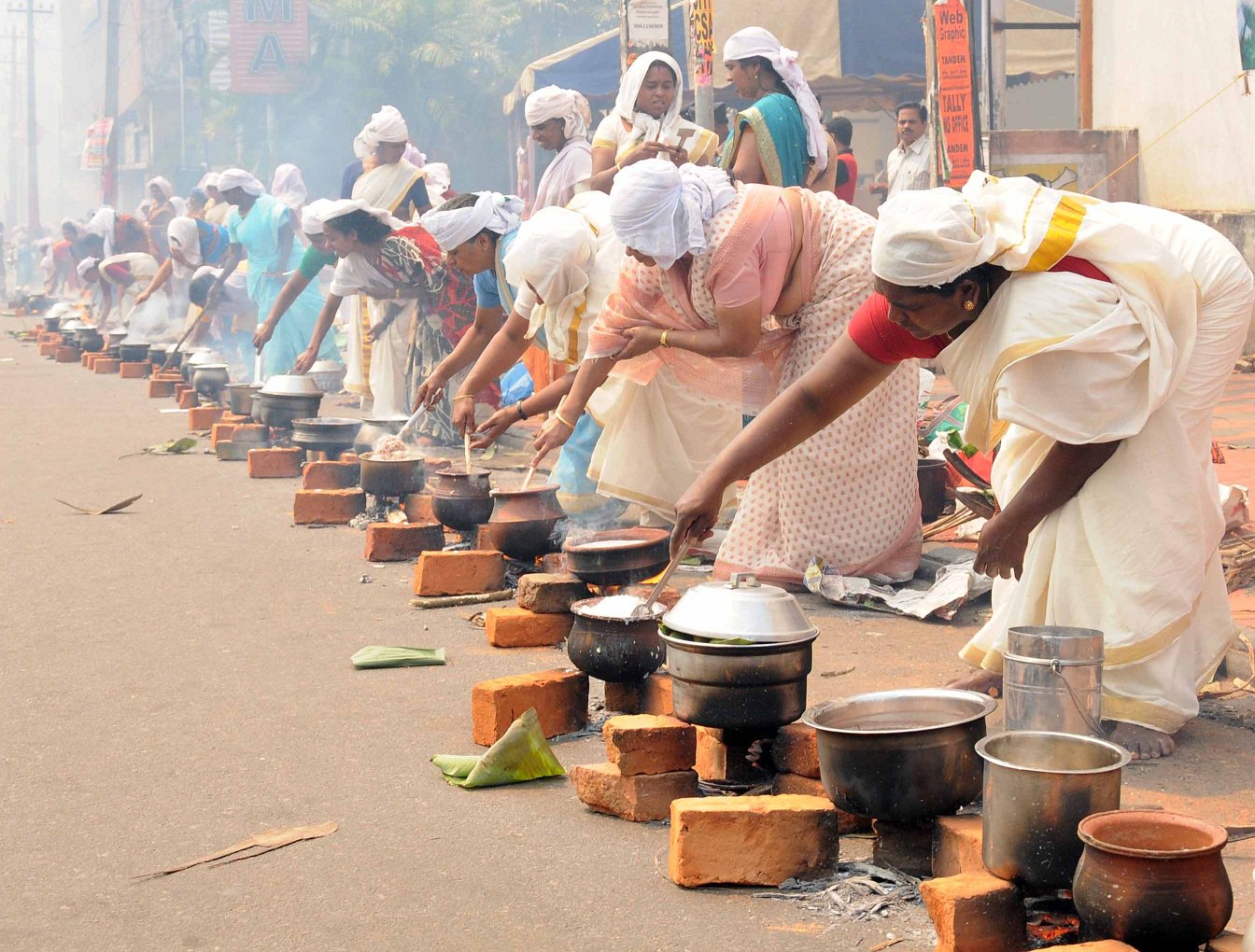
Attukal Pongala is one of the most sacred and spiritually charged festivals in Kerala’s Shakti tradition, drawing over four million women devotees to Thiruvananthapuram every year in the Kumbham month. Falling on the auspicious Pooram Nakshatra during Purnima, this festival carries deep astrological potency and profound religious significance, commemorating the divine fury and compassion of Goddess Kannagi – an incarnation of Bhadrakali, through a collective fire offering of sweet rice that transforms an entire city into a living Yagashala.
What is Attukal Pongala
The word Pongala derives from the Tamil-Malayalam root meaning “to boil over.” It refers both to the festival and to the sacred offering – a sweet payasam of rice, jaggery, and coconut cooked in earthen pots over open hearths. When the mixture boils and spills over the rim, it is considered the most auspicious moment of the ritual, a visible sign that the Goddess has accepted the offering and is bestowing abundance upon the devotee.
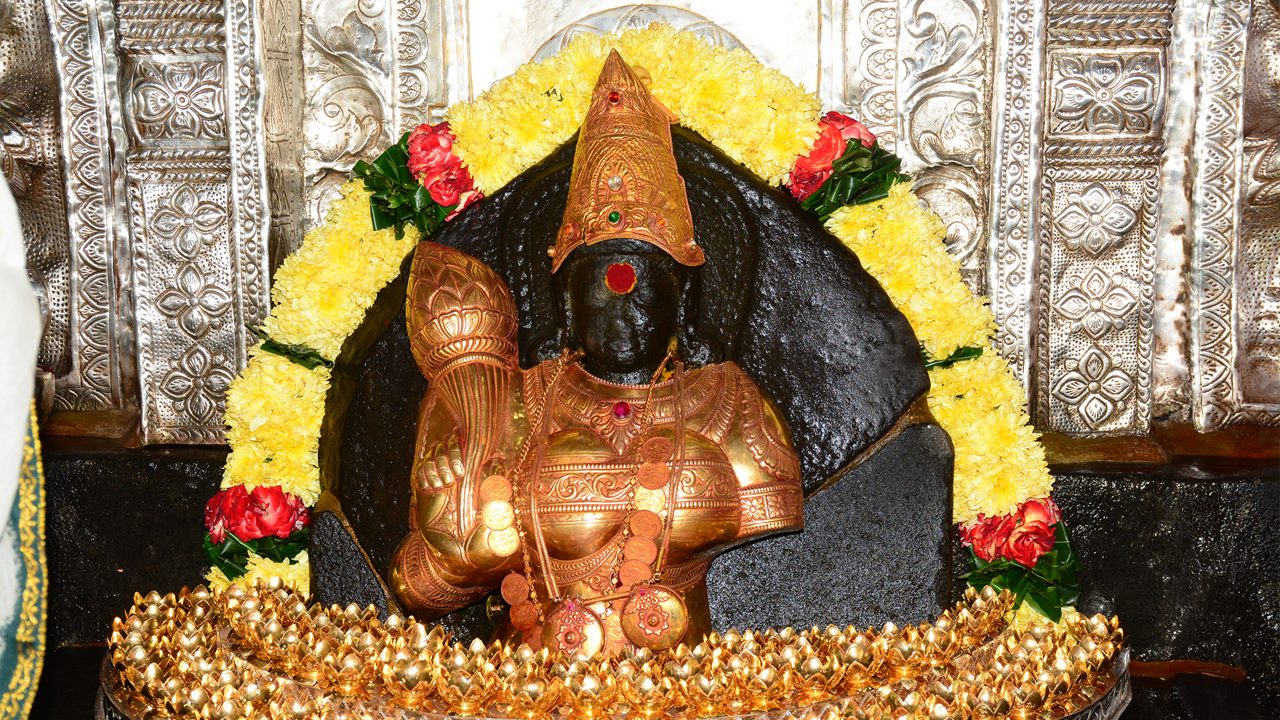
The festival is observed at the Attukal Bhagavathy Temple, located approximately two kilometers from the famous Padmanabhaswamy Temple in Thiruvananthapuram, Kerala. The presiding deity, affectionately called Attukal Amma, is identified with Goddess Kannagi from the ancient Tamil epic Silappathikaram and revered as a fierce yet compassionate form of Bhadrakali.
Often called the “Sabarimala of Women”, Attukal Pongala holds a place in Kerala’s religious calendar comparable to the great Sabarimala pilgrimage – an exclusive, mass expression of devotion, faith, and feminine spiritual power. It is Kerala’s oldest and most celebrated Pongala festival, blending Dravidian goddess worship with Vedic Shakti traditions.
Date, Duration, and Timing
Attukal Pongala is a ten-day festival observed in the Malayalam month of Kumbham (corresponding to February-March in the Gregorian calendar). The festival opens on the Karthika Nakshatra day with the Kappukettu ceremony and culminates on the tenth day with the Kuruthitharpanam ritual.
The spiritual peak falls on the ninth day, which aligns with Pooram Nakshatra on Purnima (full moon). This is the day of the grand Pongala offering, when millions of women cook simultaneously at the same auspicious hour.
The Aduppuvettu (hearth lighting) muhurat is announced by the temple priests each year and is strictly followed by all participants. The main Pongala begins only when the chief priest lights the Pandara Aduppu – the sacred central hearth inside the temple and its flame is passed outward across the city like a river of fire.
Astrological Significance of Attukal Pongala
Kumbham Month and Feminine Energies
The festival’s placement in Kumbham masa (when the Sun transits Aquarius/Kumbha rashi) is not incidental. This period marks the gradual shift from winter toward spring, a transitional window in the Vedic calendar where Shakti energies are naturally heightened, making it an ideal time to invoke the Divine Mother.
Pooram Nakshatra and Mars
The primary Pongala ritual falls on Pooram Nakshatra (also called Purva Phalguni in Sanskrit), which is ruled by Shukra (Venus) in some classifications but associated with fierce protective energies in Kerala’s tantric tradition. The conjunction of Pooram with Purnima (full moon) amplifies devotional intensity and the power of collective prayer.
Full moon days are inherently auspicious for Shakti upasana (goddess worship). The lunar energy on Purnima is at its peak, and combined with Pooram, it creates a muhurat of exceptional potency for invoking blessings of protection, prosperity, and the removal of obstacles.
The Sacred Fire as Cosmic Yajna
From a Jyotish perspective, the mass lighting of millions of hearths simultaneously creates what is essentially a city-wide Agni yajna. Fire, governed by Agni and the Sun, purifies planetary doshas when offered with mantra and devotion. The collective chanting during cooking amplifies the vibratory field, making the ritual not just personally purifying but cosmically significant.
Astrological Benefits of Observance
Participating in or observing Attukal Pongala is believed to bestow the following astrological and spiritual benefits:
- Removal of Mangal dosha through the Mars-ruled Pooram nakshatra’s pacification
- Strengthening of Chandra (Moon) energies through Purnima observance
- Graha shanti (planetary pacification) through the fire offering
- Relief from Shani-related suffering through surrender and collective devotion
- Blessings of abundance tied to Shukra (Venus) — the planet of prosperity and family harmony
Attukal Pongala draws its cosmic power from the convergence of Kumbham masa, Pooram Nakshatra, and Purnima, three astronomical factors that together create a rare window for Shakti worship of the highest order. The collective fire ritual acts as a planetary-scale yajna, purifying the atmosphere and the inner worlds of millions of devotees simultaneously. For those carrying planetary afflictions, sincere participation on this day is considered equivalent to performing a dedicated Navagraha shanti puja.
Religious Significance of Attukal Pongala
Shakta Sampradaya and Bhadrakali Worship
Attukal Pongala belongs squarely to the Shakta sampradaya – the tradition of goddess worship within Sanatana Dharma. The presiding deity, Attukal Bhagavathy, is revered as Bhadrakali, the fierce aspect of Adi Shakti who emerged from Shiva’s third eye to destroy the demon Daruka. In Kerala’s tantric tradition, Bhadrakali is the ultimate protector, riding a vetala, symbolizing her mastery over death, ignorance, and injustice.
The Tridevi in One Form
Devotees worship Attukal Amma as the Tridevi embodied in one:
- Maha Saraswati in the morning – invoked for wisdom and learning
- Maha Lakshmi in the afternoon – honored for wealth and family wellbeing
- Mahakali/Parvati in the evening – revered for power, protection, and moksha
This threefold worship through a single day reflects the completeness of feminine divinity encompassing all of creation’s aspects in the Goddess’s motherly form.
Connection to Dharma and Moksha
The festival’s core narrative, Kannagi’s fight against the Pandyan king’s injustice is a direct illustration of dharma’s ultimate triumph. The collective offering of Pongala represents bhakti’s power to dissolve karma: the boiling over of the pot is symbolic of ego dissolution (ahamkara nivritti) and complete surrender at the Goddess’s feet.
The Pongala ritual connects to all four purusharthas: it is a dharmic act of devotion, it seeks artha (prosperity) for the family, it fulfills the kama (desire) for divine connection, and through sincere surrender, it opens the path to moksha.
The Deity: Attukal Bhagavathy
Primary Form and Iconography
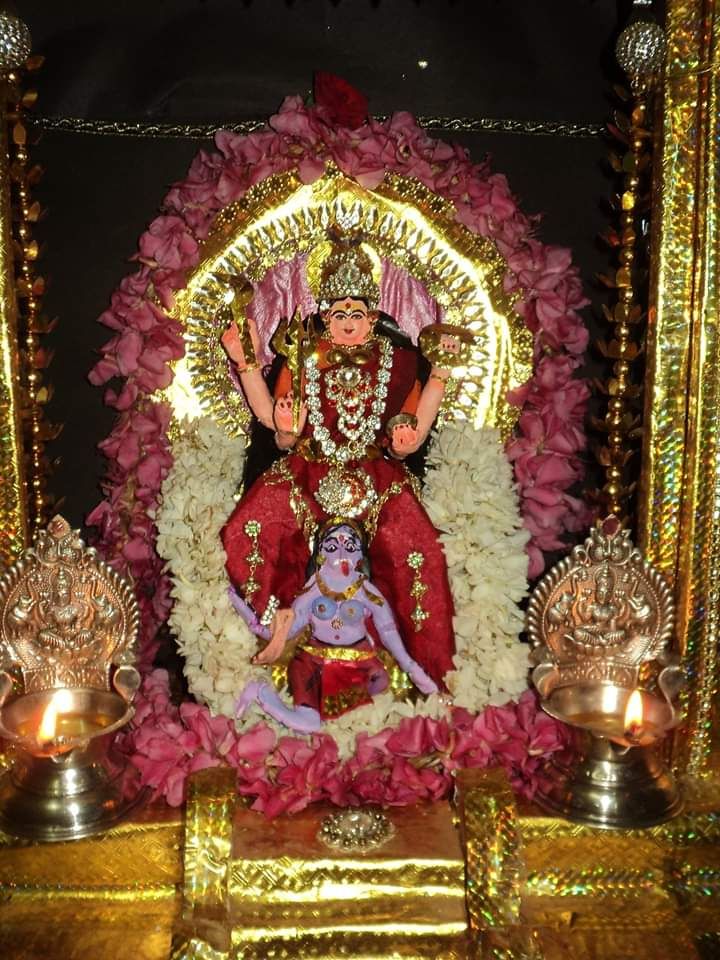
The sanctum murti of Attukal Bhagavathy depicts the Goddess in a dynamic, victorious form mounted on a vetala (a supernatural being), conveying her absolute authority over the forces of darkness. She holds weapons in multiple arms, her expression combining fierce resolve with maternal compassion.
Her identification with Kannagi from the Silappathikaram positions her uniquely, she is simultaneously a historical-mythological heroine, a cosmic Shakti, and an accessible mother figure to whom ordinary women can bring their everyday prayers.
Regional Connections
The festival’s opening Kappukettu invokes the presence of the Goddess from Kodungallur Kurumba Temple, one of the principal Shakti shrines of Kerala, establishing a sacred link between the two temples. This regional connection underscores how Kerala’s goddess tradition flows as a continuous, living current across its landscape.
Sacred Legend and Katha
Kannagi’s Story from the Silappathikaram
The Cilappatikaram (Silappathikaram), composed by the Jain poet Ilango Adigal around the 5th-6th century CE, narrates the story that forms the spiritual foundation of Attukal Pongala.
Kannagi was born to a wealthy merchant family in Puhar (Kaveripattinam) in the Chola kingdom. She married Kovalan, a prosperous merchant’s son, in a traditional Vedic ceremony. Their early life was filled with love and prosperity likened in the epic to divine lovers Kama and Rati entwined in worldly bliss.
Kovalan, however, fell under the spell of Madhavi, a celebrated courtesan, spending lavishly on her and abandoning Kannagi. Kannagi bore this heartbreak with the quiet dignity of a pativrata, a woman whose entire strength rests in her chastity and unwavering devotion. When Kovalan finally returned to her, penniless and repentant, she forgave him without a word of reproach offering him her precious gem-filled anklets to sell in Madurai so they could rebuild their lives.
In Madurai, a goldsmith who had stolen the queen’s pearl-filled anklet seized the opportunity to frame Kovalan for the theft. The Pandyan king Nedunceliyan, without inquiry or trial, ordered Kovalan’s immediate beheading.
When Kannagi learned of this monstrous injustice, she stormed the royal court. She broke her remaining anklet open before the king and queen, rubies spilled out, not pearls, proving irrefutably that her husband had been wrongfully killed. The king, struck by the weight of his sin, collapsed dead.
Kannagi’s righteous fury did not stop there. She tore off her left breast and hurled it at the city of Madurai, cursing it to burn for its collective guilt in allowing this injustice. Madurai was engulfed in flames, the fire sparing only the virtuous: children, women of chastity, cows, Brahmins, and the elderly. Appeased by the pleas of Goddess Meenakshi, Kannagi finally relented and her fire subsided.
The Arrival at Attukal
After the destruction of Madurai, Kannagi wandered southward toward Kerala, her grief and fury gradually giving way to a deep spiritual stillness. Near Thiruvananthapuram, she appeared as a radiant young girl to the Mulluveetil karanavar (village head) by the Killi River, requesting help to cross.
Charmed by her presence, he hosted her with humble hospitality offering her simple food prepared from rice, jaggery, and coconut. She then vanished. In his dream that night, the Goddess revealed her true identity and directed him to build a shrine where three golden lines marked the sacred ground in a nearby grove. That site became the Attukal Bhagavathy Temple.
The offering of rice, jaggery, and coconut that the local women made to appease the Goddess in her grief-stricken state became the Pongala reenacted by millions every year as an act of compassionate hospitality toward the Divine Mother.
Spiritual Teaching of the Katha
This legend teaches that truth and chastity carry a cosmic force greater than any earthly power. Kannagi’s tapas her unbroken fidelity and righteous anger was potent enough to burn a city. Yet the same woman was soothed by the simple, sincere offering of humble food by ordinary women. The Pongala ritual affirms that Shakti responds not to grandeur but to sincerity.
Complete Puja Vidhi: Step-by-Step Guide
Preparation (Previous Evening)
- Purchase raw red rice (chemba rice), jaggery, fresh grated coconut, ghee, cardamom, small elaichi bananas, raisins, and cashews
- Procure a new earthen pot or dedicated brass pot
- Arrange three bricks for a traditional hearth, or prepare a gas stove with symbolic hearth arrangement
- Keep firewood or dried coconut fronds ready if doing outdoors
- Clean the puja space and kitchen thoroughly
Morning of Pongala
Shuddhi (Purification): Take a complete bath at dawn. Wear clean traditional attire, a cotton saree is the traditional dress.
Desha Shuddhi: Clean the kitchen floor and puja area. Wash the earthen pot and apply turmeric and kumkum on its outer surface near the rim.
Devi Sthapana: Place a picture or idol of Attukal Bhagavathy in the puja area. Apply turmeric and kumkum. Offer fresh flowers and light a ghee lamp before the Devi.
Ganesha Puja: Offer a brief prayer to Lord Ganesha to remove all obstacles from the ritual.
Sankalpa: State your name, gotra (if known), and place, and mentally offer the declaration: “I am performing this Pongala for the grace of Attukal Amma and the wellbeing of my family.”
Hearth Setup: Arrange three bricks in a triangular formation. Decorate the hearth area with banana leaves and mango leaves. At home, take the flame directly from the Devi’s ghee lamp to light the stove, this is the ritual transfer of sacred fire.
Water and Boiling: Place the pot on the hearth. Add five to six cups of water for every one cup of rice. Allow the water to come to a rolling boil while chanting “Om Devi Attukalayai Namah” continuously.
Adding Rice (Three Fistfuls): Once the water boils vigorously, add the washed rice in three separate fistfuls, each accompanied by a silent prayer of surrender. Then add the remaining rice. Do not stir immediately.
The Sacred Boil Over (Pongal): Allow the rice and water to rise and spill over the rim of the pot, this is the most sacred moment. Inwardly surrender all ego, fears, and desires to the Goddess at this instant. This boiling over is the symbolic completion of the offering.
Full Cooking: Reduce flame slightly and continue cooking until the rice reaches a soft, porridge-like consistency. Add a little water if needed before introducing jaggery.
Adding Jaggery: Add grated or pre-dissolved jaggery directly into the pot. Stir continuously for five minutes until fully blended.
Final Enrichments: Add fresh grated coconut, sliced or mashed elaichi banana, raisins, cashews, and ghee gradually while stirring. Finish with powdered cardamom. Allow to thicken to a rich, scoopable consistency.
Offering to Devi: Carry the pot reverently to the puja room, facing the direction of Attukal Temple. Place before the Devi’s image. Offer flowers and a small camphor arati. Pray: “Amma, please accept this Pongala prepared with devotion. Bless my family and all beings.”
Prasad Distribution: After a few minutes of silent prayer, the offering becomes prasadam. Distribute it to all family members and, if possible, to neighbors.
Mantras for Chanting While Cooking
- Om Devi Attukalayai Namah – repeat continuously in a gentle rhythm
- Amme Narayana, Devi Narayana, Lakshmi Narayana, Bhadre Narayana
- Sarvamangala Mangalye, Sive Sarvartha Sadike, Sharanye Tryambake Devi, Narayani Namostute
Maintain mauna (inner silence) as much as possible during cooking, avoid casual conversation and phone calls. Treat the entire process as a moving meditation, a seva to the Divine Mother.
Where Attukal Pongala is Celebrated
Primary Site: Thiruvananthapuram
The heart of the festival is the Attukal Bhagavathy Temple, a 15-acre sacred complex housing the deity and associated shrines. On Pongala day, the ritual area expands outward in a 7-8 km radius, converting the entire city into a consecrated ground. Every street, lane, and open space becomes a hearth site.
Ritual processions connect the Attukal Temple to the Manacaud Sastha Kovil, where the Goddess’s idol travels on the ninth night and returns the following morning.
Home Observance (Nationwide and Global)
Devotees who cannot travel to Thiruvananthapuram observe Pongala at home in their backyards, kitchens, or courtyards aligning with the announced muhurat. The directional connection to the temple is maintained through prayer. This practice ensures that no devotee is excluded from the Goddess’s grace due to distance.
Communities of Keralites across India and in countries like the United States, the United Kingdom, the UAE, Singapore, and Australia observe Attukal Pongala collectively, often gathering at local temples or community centers.
Cultural and Social Dimensions
Attukal Pongala transcends the individual act of worship. On this day, women from all castes, social backgrounds, and even religions including Christian women cook side by side on the streets, their hearths touching, their prayers mingling in the air. Social hierarchies dissolve in the fire of collective bhakti.
The festival also includes special observances for children:
- Kuthiyottam : boys under twelve undergo a seven-day penance at the temple, representing the wounded soldiers of the Goddess
- Thalappoli : girls under twelve carry decorated plates to receive the Goddess’s blessings for health and beauty
The processions on the eighth and ninth days feature decorated elephants, colorful floats, classical music, and Kerala folk arts creating a festival atmosphere that is as much a celebration of culture as it is an expression of spirituality.
Do’s and Don’ts on Attukal Pongala
Do’s:
- Bathe and wear clean, modest traditional clothes
- Maintain inner focus and chant mantras while cooking
- Light the hearth from the Devi’s lamp as a sacred act
- Allow the Pongala to boil over without interference
- Share prasadam with neighbors and the less fortunate
Don’ts:
- Avoid casual conversation, arguments, or phone use during cooking
- Men must not approach or assist in the cooking during the main ritual
- Do not begin cooking before the announced muhurat
- Do not use pre-cooked or instant rice for the offering
- Avoid impure thoughts or words during the entire observance
FAQ Section
1. What is Attukal Pongala? It is a ten-day festival at Attukal Bhagavathy Temple in Thiruvananthapuram, Kerala, where millions of women cook a sacred sweet rice offering called Pongala to seek the blessings of Goddess Attukal Amma.
2. What does “Pongala” mean? Pongala means “to boil over” in Tamil-Malayalam, symbolizing abundance, prosperity, and divine acceptance of the offering.
3. When is Attukal Pongala celebrated? It falls in the Malayalam month of Kumbham (February-March), peaking on Pooram Nakshatra during Purnima, the full moon, on the ninth day of the festival.
4. Who is Attukal Amma? She is the presiding deity of the Attukal Bhagavathy Temple, revered as Bhadrakali and identified with Kannagi, the heroine of the Tamil epic Silappathikaram. She is also worshipped as the Tridevi – Saraswati, Lakshmi, and Parvati in one form.
5. What is the astrological significance of Attukal Pongala day? It falls on Pooram Nakshatra during Purnima in Kumbham masa, a rare convergence that amplifies Shakti energies, makes planetary doshas more responsive to remedies, and intensifies the power of collective devotional fire.
6. Why is it called the “Sabarimala of Women”? Like the Sabarimala pilgrimage, which draws millions of male devotees, Attukal Pongala is an exclusive, massive, women-centric religious gathering — making it the feminine counterpart of that great pilgrimage tradition.
7. What Guinness World Record does it hold? It holds the record for the largest annual gathering of women for a religious activity growing from 1.5 million in 1997 to over 4 million in recent years.
8. Can women of other faiths participate? Yes. Women from all faiths, including Christians, are known to participate and offer Pongala, reflecting the festival’s inclusive, non-sectarian spirit.
9. Can men participate in the Pongala ritual? Men are welcome at the temple on other days, but the main Pongala cooking ritual is exclusively performed by women.
10. What are the main ingredients of Pongala? Raw red rice (chemba rice), jaggery, fresh grated coconut, ghee, cardamom, small elaichi bananas, raisins, and cashews cooked in an earthen pot.
11. What is the Pandara Aduppu? It is the sacred central hearth inside the Attukal Temple, lit by the chief priest to signal the start of Pongala. The flame is then passed from woman to woman across the city.
12. What is the significance of the “boiling over”? When the Pongala pot boils over, it is considered a sign of divine acceptance and abundance. Spiritually, it symbolizes ego dissolution and complete surrender to the Goddess.
13. What is Kappukettu? It is the opening ceremony on Day 1, where the deity is adorned with sacred bangles and the Kannaki Charitam, the story of Kannagi begins to be sung.
14. What is Kuruthitharpanam? It is the final ritual on the tenth day, a symbolic blood sacrifice (offered through red liquid) for purification, marking the conclusion of the festival.
15. What is Kuthiyottam? It is a seven-day penance performed by young boys under twelve at the temple, representing the wounded divine soldiers of the Goddess. It concludes on the tenth day.
16. What is Thalappoli? Young girls under twelve carry beautifully decorated plates in procession to receive the Goddess’s blessings for health and beauty.
17. What should I bring to participate near the temple? A new earthen pot, three bricks for a hearth, dried coconut fronds or firewood, and the Pongala ingredients – rice, jaggery, coconut, ghee, and spices.
18. Is there an entry fee? No. Participation in the public Pongala ritual and entry to the temple are free of charge.
19. What is the dress code? Modest traditional attire, a cotton saree or Kerala set mundu is expected and respectful.
20. How do I perform Attukal Pongala at home? Set up a Devi image, light a ghee lamp, find the direction of Attukal Temple, align with the announced muhurat, light your hearth from the Devi’s lamp, and cook the Pongala payasam while chanting Devi mantras.
21. What is Kannaki Charitam? It is the poetic recitation of Kannagi’s story from the Silappathikaram, sung daily from the first day of the festival through the ninth day.
22. Are there other special offerings apart from Pongala? Yes. Devotees also prepare Manda puttu (steamed balls with green gram) and Therali appam (rice and jaggery steamed in aromatic vayana leaves) as additional sacred offerings.
23. What planetary doshas can be relieved by observing this festival? Sincere Pongala observance is believed to relieve Mangal dosha, Chandra-related afflictions, and general Navagraha suffering through the combined power of Shakti upasana and fire offering.
24. What is the connection between Attukal and Kodungallur Bhagavathy? The festival’s opening Kappukettu ceremony invokes the Goddess from Kodungallur, establishing a ritual connection between the two major Shakti shrines of Kerala.
25. What spiritual fruits (phala) are obtained from Pongala observance? Devotees receive blessings of family prosperity, health, freedom from planetary afflictions, fulfillment of sincere desires, and through complete surrender spiritual liberation (moksha).
Conclusion
Attukal Pongala is not merely a festival. It is a living, breathing proof that devotion, when it is collective, sincere, and rooted in dharma, becomes an unstoppable cosmic force. When millions of women light their hearths at the same moment, stirring the same sacred mixture and chanting the same names of the Goddess, the boundary between the human and the divine dissolves as completely as jaggery in a boiling pot.
The legend of Kannagi reminds us that justice, chastity, and the righteous heart of a woman carry a fire that even kings cannot withstand. And the offering of Pongala – simple rice, sweetened with jaggery, enriched with coconut and ghee, reminds us that the Divine Mother is not won over by grandeur. She is moved by sincerity.
Whether you stand in the streets of Thiruvananthapuram surrounded by millions, or kneel before a small diya in your home facing the direction of the temple, Attukal Amma sees your heart before she sees your pot. That is the deepest teaching of Attukal Pongala and the reason this sacred festival endures, grows, and continues to transform lives across generations.
Amme Devi Attukal Amme Saranam!
Help Us Keep This Guide Accurate
At Temple Connect, we regularly update our content to ensure you receive the most relevant and authentic information. If you’d like to suggest improvements, share regional traditions, or report any updates, we’d love to hear from you at connect@templeconnect.com
Follow us on our X platform.
Note to Readers: This article is intended for educational and devotional purposes. The information presented is based on traditional Hindu scriptures, contemporary religious practice, and scholarly research.
Individual observance may vary based on family tradition, regional custom, and personal circumstance. For specific guidance, especially regarding complex astrological remedies, please consult qualified priests, pandits, or Vedic astrologers. The health-related aspects mentioned are traditional beliefs and should not replace professional medical advice.